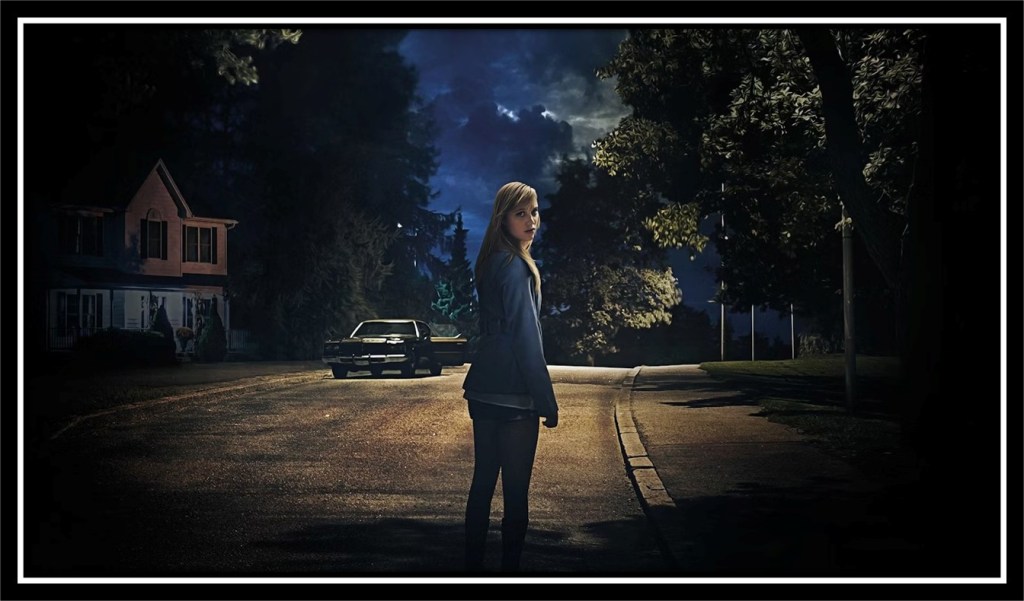
Since its debut in 1984, A Nightmare on Elm Street has amassed six sequels, a TV series, a crossover movie and a remake, making it one of the most successful franchises in horror history. However, despite Freddy Krueger’s lasting popularity with audiences, it has been fourteen years since the character’s last official on-screen outing in the ill-fated remake.
Ever since that disappointing reboot, fans have been desperate for another film in the series, but sadly as the years drag on, it feels less and less likely. Whilst there might be little hope of a direct continuation of the A Nightmare on Elm Street saga, there are films that capture the same mood and magic as Wes Craven’s movie. Of these titles, I argue that the most similar is David Robert Mitchell’s 2014 movie, It Follows.
It Follows joins teenage girl Jay as she becomes the unwilling recipient of an STD – Sexually Transmitted Demon; a supernatural entity passed to her via sexual intercourse that is intent on claiming her life. The only way to escape its clutches, temporarily at least, is to ‘pass’ it on to another.
It Follows might have a different story, and lack a fedora-clad killer, but it does share enough DNA with Craven’s classic to deem it a worthy successor to the A Nightmare on Elm Street throne. My presentation will highlight ten key similarities between the two films, including parallel characters and sequences, sharing an out of time, hazy dreamlike quality, and more. I hope that in exploring the shared traits of these two movies, I will provide you with a new perspective, and encourage a reassessment of what exactly makes an A Nightmare on Elm Street movie.
Raison d’etre

Before delving into the similarities between A Nightmare on Elm Street and It Follows, it is important to acknowledge one of the key points of difference between the pair – the raison d’etre of the threat.
In A Nightmare on Elm Street Freddy Kruger has targeted Nancy and her friends because of their parents who, after learning that Kruger was a child killer, took drastic action and murdered him. Now, in death, Kruger continues his ‘hobby’ having found a way to exist in the dreams of the young and fearful. Their fear makes him corporeal and grants him a semblance of immortality. In killing these teenagers Kruger is exacting revenge on those that wronged him. His reasoning, although barbaric, is easy to understand, and very human in nature.
In contrast, the entity known as ‘It’ has no control over the selection of its victims. Instead, the cursed entity spreads like a virus, porting from one host to the next. There is no malice behind its selection like Freddy, and is somewhat indifferent in its result.
Unlike many other films such as Ring, which deal with inescapable curses, It Follows never grants the audience any information about It’s true nature. In Ring for example, after watching the cursed videotape, journalist Reiko begins investigating the phenomenon. Her research leads her to the origins of the curse and in doing so she unearths a way to potentially cease the curse. Sadly, Jay and her friends are afforded no help and have to simply stumble around in the dark. Nothing is known about the entity other than it is transmitted via sexual intercourse, and the not knowing creates a far more disturbing foe.
And now onto the similarities.
1) Inevitability of Death

Although never privy to It’s origins, it is heavily implied that the entity is immortal, a trait shared with Freddy. Death has strengthened rather than stopped Freddy. So long as there are teenagers dreaming, he will be sustained. That It and Freddy are seemingly unstoppable creates a sense of inevitability that they will always ultimately catch their prey, morphing them into angels of death.
Although the amount of information on Nancy and Jay’s supernatural foes varies, one element that both Freddy and It share is their relentless drive to acquire their victims. The mysterious It is laser focussed on a single target, and goes to great lengths, forever stalking its prey until it finally catches up to them. Much like a Terminator, It cannot be reasoned or bargained with and It will not stop until its current victim is dead. It is content to dispatch one person at a time, knowing it is unstoppable and that it therefore can take its time. This knowledge of Its inevitability is demonstrated further by the fact that each variation of It is seen calmly walking forward. It does not need to exert itself by running as the victim’s fate is already sealed.
Freddy is less concerned with focusing on one victim and spends much of A Nightmare on Elm Street juggling all of the teenagers. Before Tina is killed, information is shared that all of the teens dreamt about Freddy the previous night. The dream demon has visited them all to uncover the weakest link, and with Tina the most unsettled by her nocturnal encounter, she becomes his first victim. After Tina’s demise, Nancy appears to become Freddy’s next victim. However, after she eludes him, Krueger turns his attention to Rod, before making another play for Nancy, but after being thwarted again he decides to go after the far easier quarry of Glen. Once all the other Elm Street kids have been claimed, he finally commits 110% to getting Nancy.
Nancy’s reprieves from Freddy are mirrored for Jay as at several moments during It Follows she does manage to pass It on. First she sleeps with the boy across the street, Greg. Then after he dies, Jay drives out to the beach where she finds some boys partying on a boat, and although not seen, it is implied that Jay sleeps with one of them. This man is killed quickly and Jay once more finds herself at the top of It’s most wanted list.
2) What You Can’t See Can Kill You

Whilst Freddy and It hone in on their targets in different ways, they are both only visible to their victims. Whereas Freddy can, and does, appear in the dreams of all of the Elm Street kids, he remains invisible to those outside of the dream state. This is illustrated beautifully during A Nightmare on Elm Street’s opening death. Despite Rod having already dreamed of Freddy, he is unable to see him as he drags Tina around her parent’s bedroom. Instead, all he witnesses is his girlfriend being cut into by an invisible force, a story that does not go down well with the local police force.
It is a similar scenario with It as only those that have been cursed are able to see it. No one else can see the strange forever walking demonic force, which makes it hard for anyone outside of those afflicted to understand what is happening. Jay however, is fortunate enough to have a great friendship group around her who are willing to support her. Their support is soon rewarded with evidence as, although they cannot see what form It has taken, they are able to witness its devastation first hand.
In a scene somewhat reminiscent of A Nightmare on Elm Street, Jay’s friends do get to experience the power of It. Having fled her home, Jay and company travel to Greg’s beach house. Believing that she will be safe, at least for a little while, Jay relaxes on the beach. Behind her, Jay’s friend Yara is seen, then the camera pans to show another Yara floating in the sea, revealing the figure behind Jay as It. As Jay has her back to It, she cannot see it, and neither can her sister Kelly or friend Paul. That is, until It grabs a handful of Jay’s hair and begins pulling it. Suddenly this weird threat that Jay has been speaking about becomes real to them. Interestingly, although fixated on Jay, It has no issue with harming others as it pushes them out of the way; It views collateral damage as a necessary means to its cause.
3) Wolf in Sheep’s Clothing
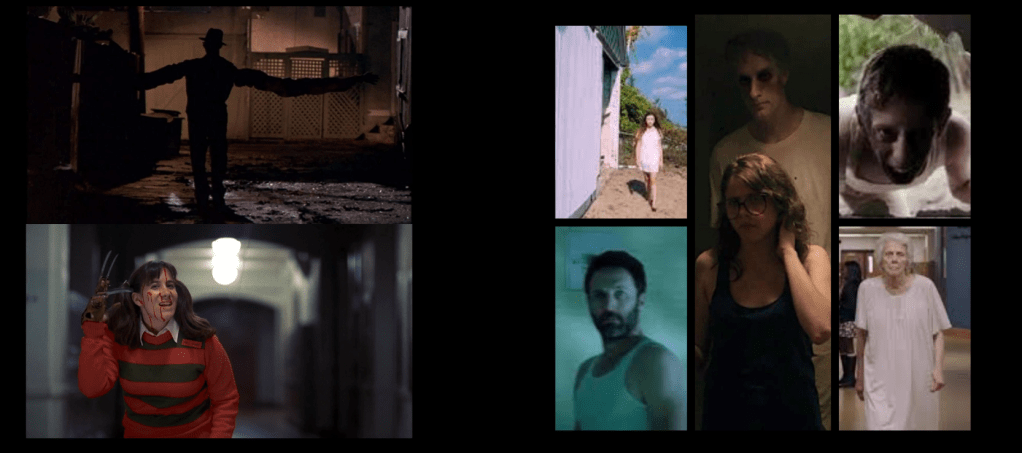
In order to claim their prey, both It and Freddy are happy to play dress-up. Their ability to mask themselves as anyone makes them a far more troubling threat than the likes of Michael Myers and Jason Vorhees who both enjoy a more uniformed appearance. Its chameleon, shapeshifting power is what makes it most terrifying to the audience. It has the ability to take on the identity of anyone, living or dead, in order to best pursue and torment its target.
Interestingly, the viewer is never privy to It’s true form – or if they are, it is never made explicit. For Jay on the whole, It takes on the form of strangers, using this to It’s advantage to try and sneak up on her. When that doesn’t work, It can be trickier to pin down, appearing as those closer to her such as Yara on the beach, and later, during the film’s climax, her father.
Freddy too is capable of changing himself, creating images that conjure maximum fear, such as his elongated arms during his first encounter with Tina. However, when the situation requires it, Kruger can camouflage as others. This is witnessed during Nancy’s dream in class. As she wanders the school hall she is challenged by the janitor for her hall pass. Initially, the janitor is nondescript, but on closer inspection, morphs into Freddy.
4) Never Sleep Again

Freddy’s other Unique Selling Point as a villain is that he strikes while the victim is sleeping. Sleep is vital to good brain function and is also necessary to provide the body with a chance to repair itself. Studies have shown that sleep deprivation can be deadly, meaning that those being hunted by Freddy risk their lives whether they sleep or not. Nancy’s mission to stay awake clearly causes her to begin to debilitate, and her plan only has a finite amount of time before ultimately her body will force itself into shutdown mode. Sleep is inescapable, and so is Freddy.
It is also an inescapable presence that inflicts sleep deprivation onto its target. Jay’s ‘boyfriend’ Hugh reveals to Jay that, until she passes It on, the entity will follow her forever. Each time Jay changes locations, It pivots and repositions its course to her, but being supernatural in nature, this entity never needs to stop for a rest. Jay however, is human, and needs opportunities to refuel and sleep and so each sanctuary is only such for a limited amount of time. As in A Nightmare on Elm Street, sleep is a dangerous venture for Jay. With her never knowing just how far It is from her at any given moment, settling down for any reasonable length of sleep is out of the question.
5) Dream Warriors
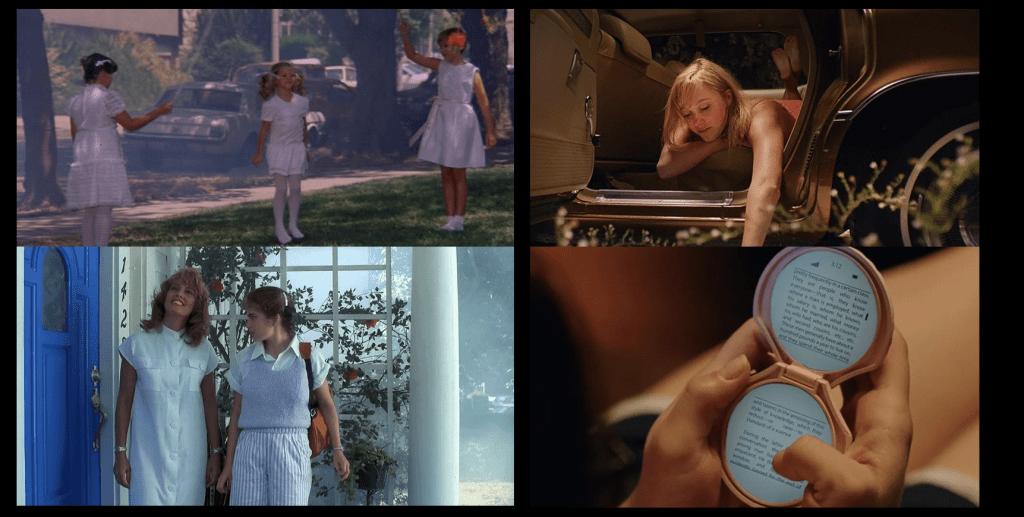
The quality of It Follows that most closely resembles Wes Craven’s A Nightmare on Elm Street, is its dreamlike vibe. Although supposedly set within the real world, almost everything about It Follows appears somehow removed from reality. This phenomenon also occurs in A Nightmare on Elm Street wherein the lines between the waking world and slumber blur on several occasions. As Nancy continues to remain awake, the audience never fully knows exactly when Nancy is awake versus dreaming.
It Follows has the same dreamlike DNA. In a similar way to A Nightmare on Elm Street, events in It Follows bleed into one another. Editing between scenes makes them appear to suddenly jump forward in time without any exposition to back this up, much like wandering through a dream when things can change drastically. Speaking about the inspiration for It Follows, David Robert Mitchell described the creation and his intention of the film to be like “a nightmare you can’t wake up from.”
It isn’t just its blending of scenes and sequences without setup that helps to evoke the dreamlike sensation. Dreams are not bound by the constraints of time and thus are timeless, an angle that both Wes Craven and David Robert Mitchell use to their advantage. Despite being forty years old, thanks to some clever choices of costuming and props, A Nightmare on Elm Street is somewhat ageless. Outside of a couple of hairstyling choices and items of clothing, the characters found within A Nightmare on Elm Street do not feel tied to the 80s.
With It Follows, David Robert Mitchell follows in Craven’s footsteps and creates a feature that has the feeling of being a nebulous liminal space of non-time. As with Nancy, the characters in It Follows feel out of time. None of the teens dress how teenagers were dressed during the films 2014 release. More than that, each member of Jay’s group almost appears to be aligning to a different fashion era. The clothing of each character is subtle and careful not to attract attention, with a closer look revealing a lack of neon, bubblegum perms or greaser styles to pinpoint an exact time period.
The technology is all over the place too, this being It Follows greatest utilisation of an out of time vibe, which ensures the movie’s longevity. Many films, especially those aimed at teenagers, do everything that they can to draw in the young. Whilst this tends to work for the initial release, it doesn’ take long for some new piece of technology to arrive and render those films in question, obsolete.
2009’s Jennifer’s Body is a prime example of this. Throughout the film there is mention to MySpace. These references immediately cause Jennifer’s Body to be associated with that specific period in time, and heavily dates it. 2022’s Bodies Bodies Bodies is set to be another that falls into this pitfall. The start of the film sees the partying teens all posting to TikTok, and Twitter etc, via their current top-of-the-line technology,. Even now, just two years on, some of this is becoming dated. David Robert Mitchell swerves this by intentionally including elements of both the past and future placing vehicles from the 50s and 60s into frame, whilst at the same time giving Yara a decidedly futuristic clamshell e-reader. Everything swirls together to create the sensation of floating through a dream and helps earn it the view that it is a stealth reversioning of A Nightmare on Elm Street.
The next few points highlight the more direct similarities between the two films in a grouped section I’ve called New Nightmare.
6) New Nightmare – Glen Reborn

Although the two narratives are entirely different, both It Follows and A Nightmare on Elm Street do share some parallel components. Firstly, both can be classed as supernatural slashers and as such they each possess variations on similar stock characters. Whereas Nancy is the prime example of the good sex-wary bookish final girl, Jay is far from that mould. In fact, when judged on her actions, dress style, and appearance, she conforms closer to Tina. Similarly Jay’s sister Kelly and friend Yara don’t adhere to any of the iconic slasher characters. Their male counterparts however – Greg and Paul are a much closer copy to A Nightmare on Elm Street.
A Nightmare on Elm Street was one of Johnny Depp’s very first credits. In the film he plays Nancy’s boyfriend Glen, a teen who just happens to live across the street from her. Less sporty and more sensitive than Rod, Glen comes across as more of a companion to Nancy than lover. This is exemplified through the character of Paul in It Follows. Paul is shy, and although not her boyfriend, is obviously in love with Jay. His crush is common knowledge and the butt of many jokes within the circle. He has some traits of Glen, primarily his more bookish nature, but in Greg there are plenty more comparisons.
If Paul is the two dimensional transplantation of Glen’s personality, Greg is everything else. Even their names are similar. Played by Daniel Zavotto, who just so happens to resemble a young Johnny Depp, it is clear that Glen and Greg share some very important story beats, which in turn help cement It Follows as a continuation and distortion of the A Nightmare of Elm Street brand. Like Glen, Greg is the boy who lives across the street. Although not Jay’s boyfriend, he is the first person with whom she sleeps with. The biggest likeness between the two characters however, is their deaths.
7) New Nightmare – Bedroom Massacres

After Tina, Glen has the most iconic demise in A Nightmare on Elm Street, which sees him essentially eaten by his bed, as Nancy tries to save him from across the street. Greg is the only on-screen death in It Follows, which by default makes it the most memorable of the film. The sequence in which Greg perishes is almost beat for beat the same as in A Nightmare on Elm Street, right down to his mother being one of the very last people to see him alive, and him dying inside the confines of his bedroom as Jay desperates attempts to prevent it. Her attempts however, are in vain, and Greg perishes. His death might not include being eaten by a bed, but that he is killed by his own ‘mother’ during an enforced coitus, certainly sticks in the memory.
8) New Nightmare – Suburbia in Danger

It isn’t just some of the characters that are familiar, the suburban setting of It Follows is also the same as A Nightmare on Elm Street. Jay and sister Kelly are seen at several points walking down the street to their homes, which are as nondescript and suburban as those found on Elm Street.
Both films approach suburbia’s inclusion to make different statements. David Robert Mitchell utilises suburbia to confront Jay and company with the stark reality of what lies beyond the picket fences. In contrast, Craven uses houses as a simple way to assign class and status to the characters whilst at the same time giving parents nightmares as it highlights that the suburbs might not be as safe as they hope them to be.
9) New Nightmare – School Daze

Modern filmmakers often take inspiration from the films that came before them, with some opting to deliberately homage the work of their heroes, but that does not appear to be the case with It Follows. Instead, Mitchell seems to have unconsciously written scenes close in tone and style to A Nightmare on Elm Street, whilst still keeping his own voice. I’ve already mentioned the aggressive demise of Greg, but there is another sequence that plays eerily similarly to A Nightmare on Elm Street.
The day after Jay sleeps with Hugh and receives the curse, she is back at school. This story beat echoes Nancy’s return to school after Tina’s death. Nancy is adamant about retaining normality and sees attending classes as a way to restore that, however once in class, she falls asleep, leading to a dream featuring Freddy and in turn her having a freak out. In It Follows Jay is seen in class struggling to concentrate. Her attention drifts to the window where she sees a figure slowly stalking towards her. Panicked, she races out of the classroom and finds herself confronted with the figure in the hallway. Spooked by the experience, she flees.
For both girls, it is this school-set sequence that affirms to them that what they are experiencing is real. For Jay she realises that she is the only one who can see the elderly woman standing in front of her, and Nancy realises that her dreams can hurt her.
10) The Final Nightmare
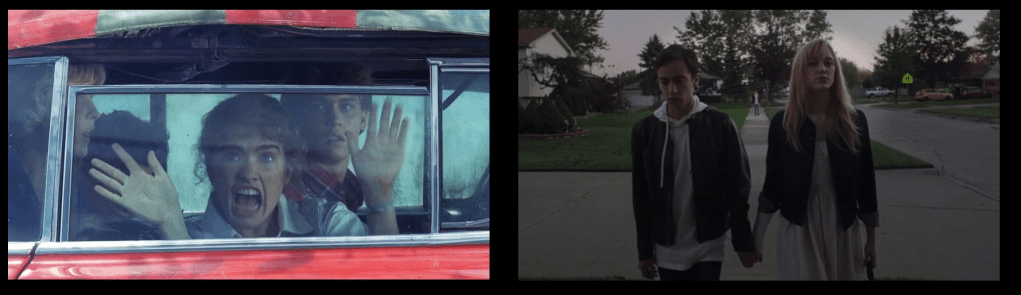
A final plot similarity comes in the closing moments of the two films, as each leaves the viewer on something of a cliffhanger. During the climax of A Nightmare on Elm Street it appears as though Nancy has managed to vanquish Freddy. This relief is short-lived however, as the final scene reveals otherwise. What starts out with Nancy and her mother discussing her school day is soon unveiled to be a dream featuring all of Nancy’s dead friends. Nancy remains oblivious to their apparent resurrection and only realises she is unsafe when the car she gets into changes to Freddy coloured stripes and traps the teenagers inside. A Nightmare on Elm Street ends with the fate of Nancy hanging in the balance and posits the notion of whether it is real or not. Is Freddy back or is Nancy just reliving her most recent trauma through her now ordinary nightmares?
David Robert Mitchell presents his own spin of Wes Craven’s trick in It Follows. After the encounter with It at the swimming pool, and without concrete evidence that It has been defeated, Jay enacts Paul’s plan B. This sees Jay sleep with Paul, who in turn visits a sex worker. The teens hope that a sex worker is best positioned to be able to continually pass on the STD to others. However, the film’s final few shots call into question how well this plan has worked. Jay and Paul are seen from behind, walking hand-in-hand down an empty street; the camera then changes angles to position itself in front of them. In the background a sole figure is seen walking towards them. Is this It, or just an innocent bystander? The film ends there and much like A Nightmare on Elm Street leaves itself open to interpretation.
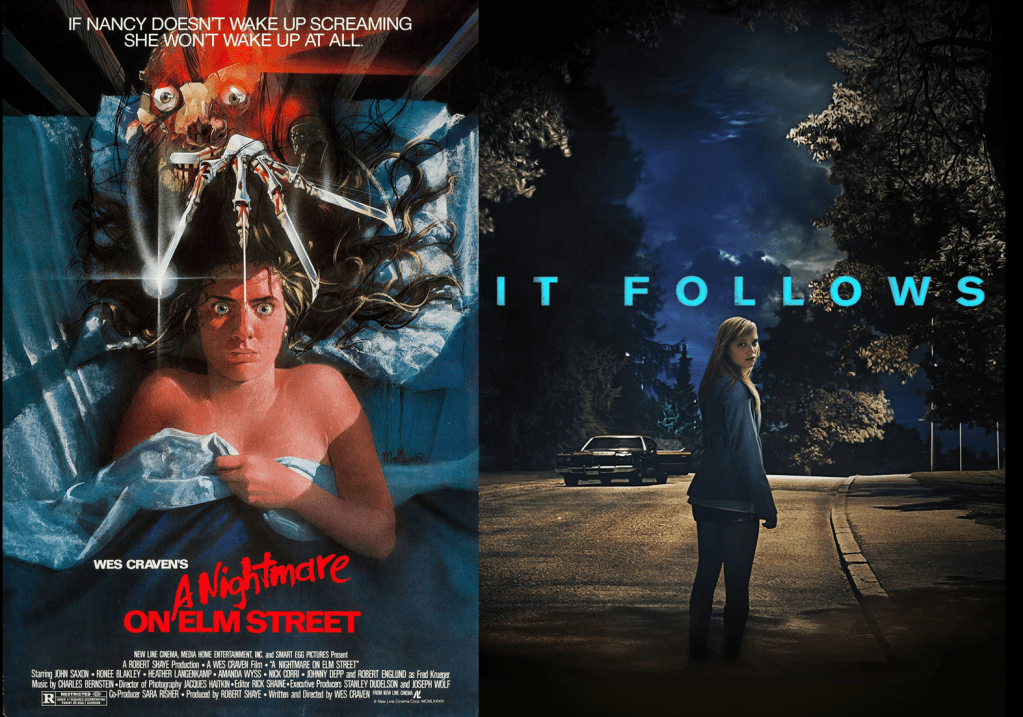
So whilst on paper they are completely different, there are an uncanny amount of similarities between A Nightmare on Elm Street and It Follows. Like A Nightmare on Elm Street, It Follows has gone on to be viewed as one of the greatest modern horror films. What many don’t realise though, is that this reaction is down to it having the essence of A Nightmare on Elm Street woven into its fabric. In a world of dodgy remakes and lacklustre sequels, I’ll happily take a film that uses the DNA and building blocks of the classic to create a movie that feels intrinsically the same but on the surface presents itself differently.
 Film Disclosure
You must be logged in to post a comment.